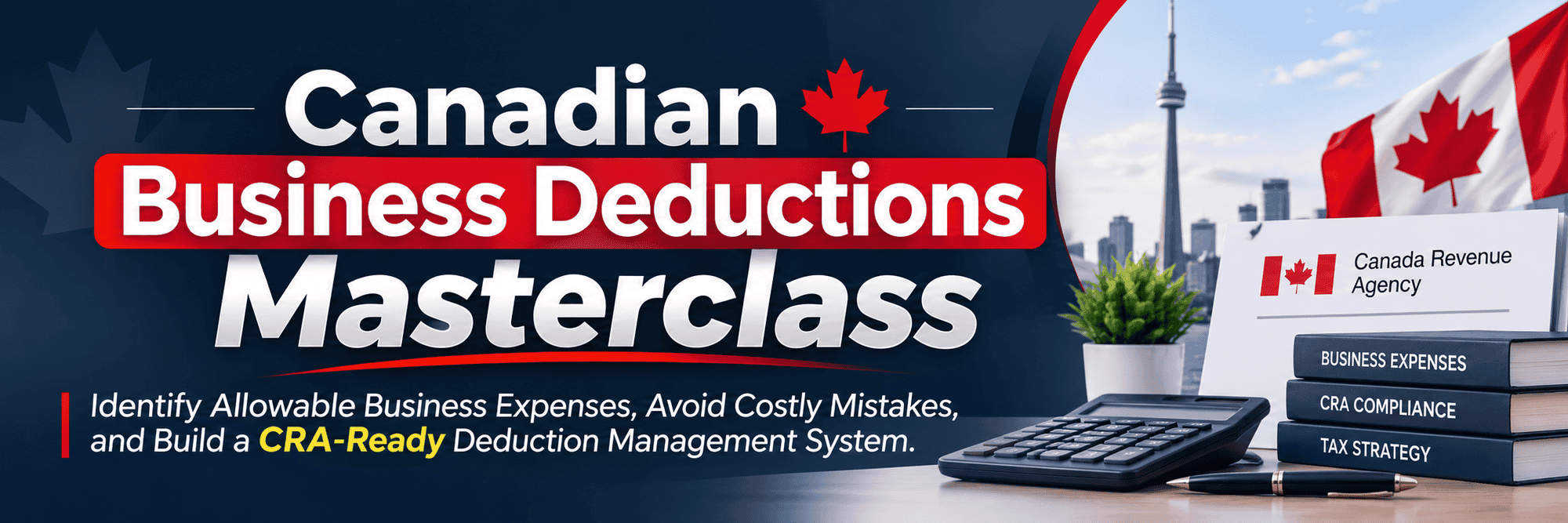
CANADIAN BUSINESS DEDUCTIONS MASTERCLASS Watch Preview
Stop Guessing What You Can Deduct. Build a System for Managing Your Business Deductions All Year.
Learn how to identify legitimate Canadian business expenses, improve your documentation, manage mixed-use costs, maintain stronger vehicle and travel records, recognize business assets and CCA issues, and prepare cleaner information for your bookkeeper and accountant.
Built specifically for Canadian business owners.
DO YOU REALLY KNOW WHAT'S HAPPENING TO YOUR BUSINESS EXPENSES?
Most business owners know that legitimate business expenses can reduce taxable business income.
The problem is often not knowing that expenses exist.
The problem is managing them properly.
Think about your own business.
Do you sometimes pay business expenses personally?
Do personal charges occasionally appear on a business credit card?
Do you use your cellphone, internet, vehicle or home for both business and personal purposes?
Could you produce your business kilometre records if you needed them?
Do you know which significant purchases may be business assets rather than ordinary current expenses?
Can you find the documentation supporting your major business expenses?
Do you know what happened to business assets that were sold, traded or disposed of?
Do you review GST/HST documentation separately where applicable?
And when something is technically uncertain, do you have a system for identifying it before tax time?
If some of those questions are difficult to answer, the problem may not be a lack of tax deductions.
The problem may be the system behind them.
THIS IS NOT ANOTHER LIST OF “TAX WRITE-OFFS”
You can find lists of possible business expenses almost anywhere.
Advertising.
Office supplies.
Professional fees.
Software.
Travel.
Vehicles.
Meals.
Insurance.
Training.
Equipment.
But knowing the name of an expense does not tell you:
Whether the expense has a genuine business purpose.
Whether part of it is personal.
What records you should maintain.
Whether a limitation or special rule may apply.
Whether a significant purchase should be treated as a current expense or capital property.
Whether CCA needs to be considered.
Whether the transaction has been recorded twice.
Whether a legitimate expense was missed entirely.
Or whether the transaction should be reviewed by a tax professional.
That's why this Masterclass takes a different approach.
INTRODUCING THE BUSINESS DEDUCTION MANAGEMENT SYSTEM
The Canadian Business Deductions Masterclass helps you build a repeatable system for managing business deductions throughout the year.
Instead of waiting for tax season and asking:
“What can I write off?”
you build a process around:
➢ CAPTURE
Make sure legitimate business expenses enter the system.
➢ DOCUMENT
Maintain the information needed to explain what happened.
➢ SEPARATE
Identify business, personal and mixed-use costs.
➢ CLASSIFY
Understand what the business actually purchased.
➢ REVIEW
Identify unusual transactions, assets and technical issues.
➢ RESOLVE
Move uncertain or material tax questions to professional review.
➢ MAINTAIN
Operate the system throughout the year.
The goal is simple:
Capture every legitimate business expense, support it appropriately, and allow the correct Canadian tax treatment to be applied.
THE FOUR QUESTIONS YOU'LL LEARN TO ASK
For every significant business expense:
➢ IS IT LEGITIMATE?
Is there a genuine business purpose?
➢ IS IT COMPLETE?
Has the legitimate expense actually entered your records?
➢ IS IT DOCUMENTED?
Can you support what happened and why it related to the business?
➢ IS IT TREATED CORRECTLY?
Have personal use, capital treatment, limitations and other Canadian ➢ tax issues been considered?
These four questions become the foundation of your Business Deduction Management System.
WHAT YOU'LL LEARN
Inside the Masterclass, you'll learn how to:
✓ Identify legitimate business expenses more systematically
✓ Establish and document business purpose
✓ Separate business and personal spending
✓ Handle expenses paid personally for the business
✓ Identify personal expenses paid by the business
✓ Deal with mixed business/personal expenses
✓ Build stronger home-based business records
✓ Maintain business vehicle and kilometre records
✓ Organize business travel documentation
✓ Improve meals and entertainment records
✓ Organize employee and contractor costs
✓ Recognize worker-classification issues requiring professional review
✓ Distinguish routine expenses from potential capital property
✓ Build and maintain a Business Asset Register
✓ Prepare the facts needed for CCA review
✓ Track assets through eventual disposition
✓ Find legitimate business expenses that may have been missed
✓ Improve receipt and invoice documentation
✓ Build stronger audit-ready expense files
✓ Organize GST/HST documentation where applicable
✓ Create a Professional Review Queue for technical questions
✓ Work more efficiently with your bookkeeper and accountant
✓ Establish monthly, quarterly and annual deduction-management routines
YOUR COMPLETE 12-MODULE MASTERCLASS
➢ MODULE 1 — Build the Right Deduction Mindset
Understand why legitimate deductions get missed and why deduction management requires more than a list of possible expenses.
You'll begin building the mindset behind your Business Deduction Management System.
➢ MODULE 2 — Build Your Deduction Decision System
Learn how to establish business purpose, identify personal components, review mixed-use expenses, distinguish current expenses from potential capital property, and identify issues requiring professional review.
➢ MODULE 3 — Find the Everyday Business Expenses
Work through common operating costs including office and administrative expenses, software and apps, professional fees, banking and processing costs, insurance, licences, memberships, repairs and maintenance.
➢ MODULE 4 — Marketing, Sales & Customer Acquisition
Learn how to organize advertising, websites, online tools, content creation, networking, events, gifts, promotions and other customer-acquisition costs.
➢ MODULE 5 — Mixed Business & Personal Expenses
Build a disciplined approach to mixed-use costs.
Work through home-based business use, phone and mobile costs, internet and technology, shared expenses and reasonable allocation methods.
➢ MODULE 6 — Vehicles, Travel & Meals
Build better records for business vehicles, kilometre tracking, vehicle expenses, business travel, hotels, transportation, meals and entertainment.
Learn why the facts and documentation matter before Canadian limitations and other rules can be applied.
➢ MODULE 7 — People & Workforce Costs
Organize employee costs, contractor relationships, professional services, training, recruitment and owner-paid expenses.
Learn when worker classification and other workforce issues should move to professional review.
➢ MODULE 8 — Equipment, Technology & Business Assets
Learn how to recognize significant purchases that may require capital treatment.
Build your Business Asset Register, organize technology and equipment records, prepare CCA information and maintain records throughout the asset lifecycle.
➢ MODULE 9 — Find the Deductions That Disappear
Run a systematic search for legitimate business expenses that can easily be missed.
Review recurring expenses, subscriptions, education and resources, transaction fees and business expenses paid personally.
➢ MODULE 10 — Make Your Deductions Defensible
Strengthen the documentation behind your expenses.
Build better receipt and invoice records, business-purpose documentation, digital filing systems, mixed-use support, audit-ready expense files and record-retention processes.
➢ MODULE 11 — Build Your Year-Round System
Turn deduction management into an ongoing business process.
Build your weekly routine, Monthly Deduction Review, Quarterly Deduction Checkup, Annual Deduction Review and bookkeeper/accountant handoff process.
➢ MODULE 12 — Implement Your Complete Business Deduction Management System
Bring everything together.
Build your:
Business Deduction Management System Map
Business Deduction Master Checklist
Business Deduction Management Dashboard
12-Month Deduction Calendar
30-Day Business Deduction Implementation Plan
90-Day Deduction Improvement Plan
90-Day Improvement Scorecard
and:
Final Business Deduction Action Plan.
YOU'RE NOT JUST GETTING VIDEOS
The Masterclass includes a complete implementation package designed to help you actually operate the system.
INCLUDED: PREMIUM COMPANION WORKBOOK
Your comprehensive Premium Companion Workbook turns the lessons into practical implementation.
It contains 75 working tools and worksheets covering:
Business purpose
Expense capture
Mixed-use costs
Home-based business
Vehicles
Travel
Meals
Employees
Contractors
Business assets
CCA preparation
Documentation
Deduction leak searches
Professional review
Monthly reviews
Quarterly reviews
Annual reviews
Implementation planning
and:
Your complete Business Deduction Management System.
INCLUDED: BUSINESS DEDUCTIONS QUICK REFERENCE GUIDE
Keep the key concepts within reach after completing the course.
Your Quick Reference Guide gives you fast access to:
The Business Deduction Decision Test
Business vs. Personal Expense Quick Test
Mixed-Use Expense Decision Guide
Current Expense vs. Capital Asset Quick Test
Receipt & Documentation Checklist
Vehicle Recordkeeping Checklist
Business Travel Checklist
Meals & Entertainment Quick Reference
Home-Based Business Checklist
Employee vs. Contractor Warning Signs
Business Asset & CCA Checklist
Personally Paid Expense Procedure
Missing Deduction Search
Professional Review Triggers
Monthly, Quarterly and Annual Checklists
and:
The Business Deduction Management System on one page.
INCLUDED: 15 HIGH-ACTION CHECKLISTS
Use these whenever you need a fast action-oriented review.
You'll receive:
Business Expense Capture Checklist
Business vs. Personal Expense Checklist
Receipt & Documentation Checklist
Mixed-Use Expense Checklist
Home-Based Business Expense Checklist
Vehicle Deduction Recordkeeping Checklist
Business Travel Checklist
Meals & Entertainment Checklist
Employee Expense Checklist
Independent Contractor Documentation Checklist
Business Asset Purchase Checklist
CCA Preparation Checklist
Deduction Leak Search Checklist
CRA Audit-Ready Documentation Checklist
Year-End Business Deduction Checklist
INCLUDED: 20 BUSINESS DEDUCTION TEMPLATES
You'll also receive reusable templates you can continue using after the course.
The pack includes:
Business Expense Source Map
Business-Purpose Documentation Record
Personally Paid Business Expense Log
Subscription Register
Mixed-Use Expense Allocation Record
Home-Based Business Workspace Record
Vehicle Master Record
Business Kilometre Log
Vehicle Expense Register
Business Travel Record
Meals & Entertainment Record
Contractor Documentation Record
Employee Expense Reimbursement Record
Business Asset Register
Asset Disposition Record
Missing Receipt Recovery Log
Professional Review Queue
Business Deduction Management Dashboard
12-Month Deduction Calendar
Bookkeeper / Accountant Handoff Record
INCLUDED: 100 AI BUSINESS DEDUCTION PROMPTS
Use AI as an organizational assistant—not as a substitute for professional tax advice.
Your 100 AI Business Deduction Prompts help you:
Organize transaction facts
Prepare business-purpose notes
Identify missing information
Review documentation
Organize mixed-use facts
Prepare vehicle and travel records
Review contractor files
Organize business assets
Prepare questions for your accountant
Build monthly and quarterly reviews
Create professional-review summaries
Improve your Business Deduction Management System
and more.
The prompts are specifically designed to help you organize information without asking AI to invent facts or make unsupported Canadian tax determinations.
INCLUDED: YOUR FINAL BUSINESS DEDUCTION MANAGEMENT SYSTEM
This is where the course becomes more than education.
By working through the program, you build a practical operating system containing:
✓ Business Deduction Master Checklist
✓ Business Deduction Management Dashboard
✓ 12-Month Deduction Calendar
✓ Monthly Deduction Review
✓ Quarterly Deduction Checkup
✓ Annual Deduction Review
✓ Subscription Register
✓ Mixed-Use Expense Register
✓ Vehicle records
✓ Business Travel File
✓ Meals & Entertainment Record
✓ Business Asset Register
✓ Missing Receipt Recovery Log
✓ Professional Review Queue
✓ Bookkeeper / Accountant Handoff Process
✓ 30-Day Implementation Plan
✓ 90-Day Improvement Plan
✓ Final Business Deduction Action Plan
WHO THIS MASTERCLASS IS FOR
This program is designed for Canadian:
✓ Small business owners
✓ Incorporated business owners
✓ Sole proprietors
✓ Self-employed professionals
✓ Consultants
✓ Contractors
✓ Service businesses
✓ Retail business owners
✓ Tradespeople
✓ Entrepreneurs
✓ Startups establishing their financial systems
You do not need to be an accountant or tax professional.
The objective is to help you maintain better business facts and records so the appropriate tax treatment can be determined.
THIS COURSE MAY BE ESPECIALLY USEFUL IF...
You regularly wonder what business expenses you may be missing.
You sometimes pay business expenses personally.
Business and personal spending occasionally become mixed.
You work from home.
You use a personal or corporate vehicle for business.
You travel for business.
You incur meals and entertainment costs.
You employ people or use contractors.
Your business buys computers, vehicles, equipment or other significant assets.
You have recurring software and online expenses.
You want stronger records before tax time.
You want to give your bookkeeper or accountant better information.
Or:
You simply want a more disciplined way to manage business deductions.
THIS COURSE IS NOT ABOUT AGGRESSIVE WRITE-OFFS
The purpose of this program is not to teach you how to disguise personal expenses as business deductions.
It is not about claiming everything possible.
And it is not about replacing your accountant or tax professional.
The objective is:
Capture legitimate expenses.
Separate personal costs.
Maintain stronger documentation.
Recognize issues requiring special treatment.
Obtain professional advice when appropriate.
That's why the system contains a:
PROFESSIONAL REVIEW QUEUE
When something is technically uncertain, you don't guess.
You capture:
The facts.
The amount.
The documents.
And the specific question.
Then you obtain the appropriate professional advice.
WHY YEAR-ROUND MANAGEMENT MATTERS
Compare two approaches.
➢ BUSINESS OWNER A
Waits until tax season.
Searches through email.
Looks through personal credit cards.
Tries to reconstruct mileage.
Searches for equipment invoices.
Attempts to remember business trips.
Finds transactions nobody understands.
And sends everything to the accountant.
➢ BUSINESS OWNER B
Captures expenses throughout the year.
Maintains documentation.
Records business purpose.
Updates kilometre records.
Tracks assets.
Identifies mixed-use expenses.
Flags technical questions.
Reviews records monthly.
And prepares an organized year-end handoff.
The difference isn't simply tax knowledge.
It's the system.
YOUR NEW OPERATING RHYTHM
Inside the Masterclass, you'll establish a simple rhythm:
MONTHLY — CONTROL
Capture and correct transactions while the information is fresh.
QUARTERLY — DIAGNOSE
Review trends, documentation, mixed-use costs, vehicles, assets and unresolved issues.
ANNUALLY — FINALIZE
Complete the year and prepare organized information for tax preparation.
AS NEEDED — PROFESSIONAL REVIEW
Don't guess at material or technically uncertain issues.
ABOUT YOUR INSTRUCTOR
Mansoor Suhail, MS Tax, EA
Mansoor Suhail has more than 25 years of experience in accounting and taxation.
Throughout his professional experience, he has seen how often business owners focus on the question:
“What can I deduct?”
while overlooking the systems required to capture, document and manage those deductions properly.
The Canadian Business Deductions Masterclass was developed to give business owners a more disciplined approach.
Rather than simply providing another list of possible expenses, Mansoor teaches students how to build a practical Business Deduction Management System that operates throughout the year.
WHAT YOU'LL WALK AWAY WITH
By the end of the Masterclass, you should have more than information.
You should have:
A process for identifying legitimate business expenses.
A system for documenting business purpose.
A method for dealing with mixed-use expenses.
Vehicle and travel recordkeeping processes.
A Business Asset Register.
A system for recovering missing documentation.
A Professional Review Queue.
Monthly, quarterly and annual routines.
A 12-Month Deduction Calendar.
A Business Deduction Management Dashboard.
A 30-Day Implementation Plan.
A 90-Day Improvement Plan.
And:
Your own Business Deduction Management System.
THE GOAL
The goal is not:
“Claim as much as possible.”
The goal is:
“Capture every legitimate business expense and treat it correctly.”
Sometimes your system may identify a legitimate expense that was missed.
Sometimes it may identify a personal expense that should be removed.
Sometimes it may identify a duplicate.
Sometimes it may identify a capital asset.
Sometimes it may identify an unnecessary cost.
And sometimes it may tell you:
“This needs professional review.”
All of those are successful outcomes.
READY TO BUILD YOUR BUSINESS DEDUCTION MANAGEMENT SYSTEM?
Stop relying on memory.
Stop waiting until tax season to organize your business deductions.
And stop treating deduction management as nothing more than a list of possible write-offs.
Build a repeatable system for managing your Canadian business expenses throughout the year.
WHAT YOU RECEIVE
✓ Complete 12-Module Canadian Business Deductions Masterclass
✓ Full-Length Premium eBook
✓ Premium Companion Workbook
✓ Business Deductions Quick Reference Guide
✓ 15 High-Action Checklists
✓ 20 Business Deduction Templates
✓ 100 AI Business Deduction Prompts
✓ Reusable Forms
✓ Complete Business Deduction Management System
✓ 30-Day Implementation Plan
✓ 90-Day Improvement Plan
✓ Ongoing access to the course materials according to the access terms shown at checkout
IMPORTANT COURSE DISCLAIMER
The Canadian Business Deductions Masterclass is provided for general educational and informational purposes only.
The course does not provide individualized tax, accounting, legal, financial or other professional advice.
Every business and taxpayer's circumstances can differ.
Canadian tax legislation, CRA administrative policies, rates, thresholds and other rules can change.
The treatment of a particular transaction may depend on your business structure, taxation year, use of the expenditure, supporting documentation and other facts.
Students should consult an appropriately qualified professional regarding material, unusual or uncertain tax matters.
The course does not guarantee that a particular expense will be deductible, that a particular position will be accepted by the Canada Revenue Agency, or that participation in the course will produce a particular tax result.
NO-REFUND POLICY
Because the Canadian Business Deductions Masterclass provides immediate access to digital educational content, downloadable resources, templates, checklists and other intellectual property, all sales are final.
Please review the course description, curriculum, included resources and suitability carefully before purchasing.
By purchasing the course, you acknowledge and agree to the no-refund policy, subject to any rights or remedies that cannot legally be excluded under applicable law.
Stop Managing Business Deductions Once
CANADIAN BUSINESS DEDUCTIONS MASTERCLASS
Stop Guessing What You Can Deduct. Build a System for Managing Your Business Deductions All Year.
Learn how to identify legitimate Canadian business expenses, improve your documentation, manage mixed-use costs, maintain stronger vehicle and travel records, recognize business assets and CCA issues, and prepare cleaner information for your bookkeeper and accountant.
Built specifically for Canadian business owners.
80 Lessons
Course Introduction & Disclaimer
Course Introduction & Disclaimer
Module 1: Build the Right Deduction Mindset
Lesson 1: Why Business Owners Miss Legitimate Deductions
Explores how legitimate expenses go missing through personal payment cards, overlooked subscriptions, and processor fees, establishing a prompt capture routine to keep costs in the records.
Lesson 2: What Makes an Expense a Business Expense?
Establishes the business-purpose test, distinguishing genuine business connections from personal spending and creating defensible documentation.
Lesson 3: Deductible Doesn't Always Mean 100% Deductible
Details why valid business expenses may not be immediately or fully deductible due to mixed-use allocations, statutory limits (such as meals), or capital property rules.
Lesson 4: From Tax-Time Scramble to Year-Round Awareness
Replaces chaotic year-end reconstruction with regular transaction capture and a structured review routine across weekly, monthly, quarterly, and annual intervals.
Module 2: Build Your Deduction Decision System
Lesson 1: The Business-Purpose Test
Analyzes what was bought, why it was needed, who benefited, and what evidence connects the expense to business income before determining tax treatment.
Lesson 2: The Five-Question Deduction Test
Introduces a systematic five-question screening filter (purpose, personal use, reasonableness, current vs. capital, Canadian tax rules) to assign transactions to three clear outcomes.
Lesson 3: Direct, Indirect, and Mixed-Use Expenses
Distinguishes direct project costs, general operating overhead, and mixed-use expenses, focusing on verifiable usage drivers rather than arbitrary round percentages.
Lesson 4: Current Expenses vs. Long-Term Assets
Compares consumable current expenditures with enduring capital property, evaluating repairs versus improvements, equipment financing, and basic Capital Cost Allowance (CCA) principles.
Lesson 5: When to Stop and Ask a Tax Professional
Identifies red-flag situations (complex allocations, major assets, shareholder transactions, worker classification) and establishes the Professional Review Queue.
Module 3: Find the Everyday Expenses
Lesson 1: Office and Administrative Expenses
Reviews routine supplies, printing, postage, small cash purchases, personally paid office costs, and separating consumables from long-term office furniture.
Lesson 2: Software, Apps, and Online Services
Audits recurring SaaS tools, app store receipts, duplicate software, free trials, mixed-use accounts, and foreign-currency charges using a structured subscription inventory.
Lesson 3: Professional and Advisory Fees
Classifies accounting, legal, consulting, and IT fees by the actual service delivered rather than the provider’s title, separating routine maintenance from capital acquisition projects.
Lesson 4: Banking, Payment Processing, and Financial Costs
Reconciles gross customer payments against net deposits to capture withheld processor fees, chargebacks, and separates loan principal repayments from deductible interest.
Lesson 5: Insurance, Licences, Memberships, and Subscriptions
Tracks commercial insurance policies, municipal permits, professional memberships, and industry publications, managing prepaid periods and renewal schedules.
Lesson 6: Repairs, Maintenance, and General Operating Costs
Distinguishes routine repairs that restore property to its existing function from capital improvements that enhance capacity or extend useful life.
Module 4: Marketing, Sales, and Customer Acquisition

Lesson 1: Advertising and Digital Marketing
Connects platform ad charges to specific campaigns and products, separates media spend from agency/creative fees, and monitors commercial outcomes.
Lesson 2: Websites, Domains, Hosting, and Online Tools
Inventories online infrastructure, controls domain renewals, separates hosting from payment processor fees, and flags major custom web development for capital review.

Lesson 3: Content Creation and Promotional Expenses
Links production costs (design, editing, voiceovers, stock licenses) to deliverables, separates services from long-term camera/lighting assets, and addresses unpaid owner-labour rules.
Lesson 4: Networking, Events, and Business Development
Manages event files containing registration, travel, lodging, and meals while separating personal vacation extensions and accompanying family costs.

Lesson 5: Customer Gifts, Promotions, and Entertainment
Documents promotional recipients, items, prizes, and entertainment, applying Canadian 50% meals limitations and separating personal gifts and employee benefits.
Lesson 6: Tracking Customer-Acquisition Costs
Calculates campaign Customer Acquisition Cost (CAC) and Cost Per Lead (CPL) to assess commercial viability against lifetime customer value.
Module 5: Mixed Business and Personal Expenses
Lesson 1: The Mixed-Use Problem
Establishes a five-step process to identify shared personal and business costs, select supportable drivers, and avoid all-or-nothing or unsupported deduction percentages.
Lesson 2: Home-Based Business Expenses
Evaluates Canadian qualification rules for workspaces (principal place of business or regular client meetings), measuring area ratios, separating direct vs. shared costs, and handling corporate considerations.
Lesson 3: Phone and Mobile Expenses
Analyzes business and personal usage on cellular plans, dedicated lines versus family plans, device financing, and distinguishing hardware purchases from monthly services.
Lesson 4: Internet and Technology Costs
Maps household shared connections, identifies incremental business costs, separates hardware assets from online services, and prevents duplicate entries.
Lesson 5: Utilities and Other Shared Expenses
Classifies household utilities and home maintenance by actual purpose, highlighting cautions around home CCA and major structural renovations.
Lesson 6: Building a Reasonable Allocation Method
Demonstrates how to build reproducible, evidence-based allocation calculations across vehicles, workspaces, and technology without reverse-engineering a desired tax deduction.
Module 6: Vehicles, Travel, and Meals
Lesson 1: Understanding Business Vehicle Expenses
Creates the Vehicle Master Record, separating vehicle purchases and financing from operating costs, and comparing corporate-owned versus personally owned vehicles.
Lesson 2: Business vs. Personal Driving
Classifies driving by purpose (client visits vs. personal commuting or errands) and calculates business-use ratios based on total kilometres.

Lesson 3: Mileage and Vehicle Records
Details contemporaneous logbooks, odometer documentation, vehicle-specific expense tracking, and CRA simplified logbook conditions.

Lesson 4: Business Travel
Builds trip-level files connecting agendas to airfare, lodging, and transport, while isolating personal extensions, family travel, and convention limitations.

Lesson 5: Hotels, Transportation, and Related Travel Costs
Itemizes hotel folios (separating room charges, meals, and personal extras), logs transportation modes, and reconciles foreign-currency charges.

Lesson 6: Meals and Entertainment
Applies the Canadian 50% limit to business meals and client entertainment, documenting participants and discussions while evaluating statutory exceptions.
Lesson 7: Building the Vehicle, Travel, and Meals Documentation Trail
Assembles the five-part evidence chain into audit-ready packages for vehicles, trips, and meals with recurring monthly reconciliations.
Module 7: People and Workforce Costs
Lesson 1: Employee-Related Business Costs
Tracks compensation beyond gross wages (employer CPP, EI, workers' comp, employee benefits, taxable benefits, and reimbursements vs. allowances).
Lesson 2: Independent Contractors
Evaluates worker classification factors (control, tools, chance of profit/loss, integration) to distinguish employees from contractors, managing contractor files and cross-border issues.
Lesson 3: Professional Services
Identifies the exact service delivered by outside professionals, separating routine operations from capital acquisitions and properly accounting for retainers.
Lesson 4: Training and Professional Development
Differentiates training that maintains or updates skills in an existing business from education qualifying someone for a new profession, tracking travel, meals, and benefit implications.
Lesson 5: Recruitment and Workforce Expenses
Traces hiring expenditures from job postings, agency fees, screening, and candidate travel through onboarding, equipment provisioning, and offboarding asset recovery.
Lesson 6: Owner Expenses vs. Business Expenses
Clarifies financial transactions between owners and businesses, managing owner-paid expenses, corporate-paid personal costs, shareholder loan balances, salary, dividends, and drawings.
Module 8: Equipment, Technology, and Business Assets
Lesson 1: Expense or Asset?
Examines enduring benefit, durability, repairs versus improvements, and the discretionary nature of Canadian Capital Cost Allowance (CCA) claims.
Lesson 2: Computers and Technology
Separates software services from hardware assets, network infrastructure, installation costs, mixed-use equipment, and secure data disposal.
Lesson 3: Furniture, Tools, and Equipment
Catalogs office furnishings, tools, machinery, and leasehold improvements, tracking delivery, installation, financing, and maintenance history.
Lesson 4: Vehicles and Other Major Assets
Follows major assets across their lifecycle (acquire, finance, use, improve, claim CCA, dispose/trade in), applying passenger-vehicle limits and centralized asset project files.
Lesson 5: Capital Cost Allowance (CCA) and Write-Off Concepts
Explains Canadian CCA classes, Undepreciated Capital Cost (UCC) balances, first-year rules, available-for-use timing, recapture, and terminal losses.
Lesson 6: Building Your Business Asset Register
Constructs a master asset register to track descriptions, serial numbers, custodians, locations, acquisition costs, business use, and disposal proceeds.
Module 9: Find the Deductions That Disappear
Lesson 1: Small Recurring Expenses
Identifies minor recurring costs missed by standard bookkeeping across bank accounts, cards, digital wallets, and cash.
Lesson 2: Forgotten Online Tools and Subscriptions
Builds a subscription cleanup list to detect unused, duplicate, or converted trial tools, assigning Keep, Cancel, Consolidate, or Review decisions.
Lesson 3: Education, Books, and Professional Resources
Recovers learning resources, publications, and memberships connected to current operations while separating travel and meals.
Lesson 4: Business Fees and Transaction Charges
Uncovers invisible fees withheld from settlement deposits (processing, wire, platform, FX charges) and separates loan principal from interest.

Lesson 5: Business Purchases You Paid Personally
Recovers legitimate business costs paid out-of-pocket by the owner, routing them through reimbursements or shareholder accounts without duplicating entries.
Lesson 6: Business Expenses Hidden Inside Personal Accounts
Searches personal payment wallets, app stores, and shared marketplace receipts for business items while protecting personal privacy.
Lesson 7: The Year-End Deduction Leak Search
Conducts a structured year-end audit across all payment sources, reconciling expense registers to the general ledger and logging unresolved exceptions.
Module 10: Make Your Deductions Defensible
Lesson 1: Why Documentation Matters
Explains why a general ledger entry alone is not legal proof, using five evidence questions to identify and resolve documentation gaps.
Lesson 2: Receipts, Invoices, and Proof of Payment
Compares the distinct roles of invoices, receipts, and payment records, verifying GST/HST ITC requirements, scanning paper, and recovering lost receipts.
Lesson 3: Documenting Business Purpose
Teaches how to write contemporaneous, factual business-purpose notes and retain calculations supporting mixed-use allocations.
Lesson 4: Building a Digital Receipt System
Sets up consistent digital intake workflows, standardized file-naming conventions, access permissions, backups, and monthly document reconciliations.
Lesson 5: Creating an Audit-Ready Expense File
Combines source invoices, payment evidence, purpose notes, contracts, and allocations into a complete file ready for accountant handoffs or CRA inquiries.
Lesson 6: Record Retention and CRA Readiness
Outlines CRA retention requirements (general six-year rule, longer records for capital property), electronic storage rules, and how to respond to CRA information requests.
Module 11: Run Your Deduction Management System
Lesson 1: The Monthly Deduction Review
Establishes a monthly reconciliation routine across all payment accounts to catch missing receipts, capture owner-paid costs, and log open questions.
Lesson 2: The Quarterly Deduction Checkup
Analyzes three months of reviews to detect recurring weaknesses in receipt collection, evaluate spending patterns, sample mileage logs, and close aging questions.
Lesson 3: The Annual Deduction Review
Reconciles full-year registers to the general ledger, checks prepayments and cutoffs, confirms asset additions/disposals, and organizes the annual tax handoff.
Lesson 4: The 12-Month Deduction Calendar
Maps out weekly, monthly, quarterly, and annual review cycles with assigned responsibilities, backups, and event-based triggers (e.g., major purchases).
Lesson 5: Working With Your Bookkeeper and Accountant
Distinguishes roles (owner provides facts, bookkeeper records, accountant advises), crafts specific tax questions, and logs professional decisions.
Lesson 6: Your Business Deduction Management Dashboard
Implements an operational dashboard measuring process health (missing receipts, open questions, review completion, capital flags) rather than tax savings.
Module 12: Build Your Final Business Deduction Management System
Lesson 1: Bringing Everything Together
Connects payment sources, registers, the general ledger, receipt archives, and review queues into one unified workflow without double counting.
Lesson 2: Your Business Deduction Master Checklist
Provides a comprehensive quality-control checklist to verify completeness across all capture sources, purpose documentation, allocations, and classifications.
Lesson 3: Your 30-Day Business Deduction Implementation Plan
Rolls out the system across four weekly stages: capture sources (Days 1–7), build registers (Days 8–14), test workflow (Days 15–21), and assign recurring work (Days 22–30).
Lesson 4: Your 90-Day Deduction Improvement Plan
Guides system stabilization (Days 31–60) and strengthening (Days 61–90), utilizing a 90-day scorecard to benchmark progress against starting baselines.
Lesson 5: Your Final Business Deduction Action Plan
Prioritizes high-impact unresolved items (shareholder accounts, payroll, capital assets), assigning responsible owners, deadlines, and completion criteria.
Lesson 6: Final Course Wrap-Up and Your Next Steps
Assembles all system registers, checklists, calendars, and dashboards into an operating system and conducts a full end-to-end transaction trace.